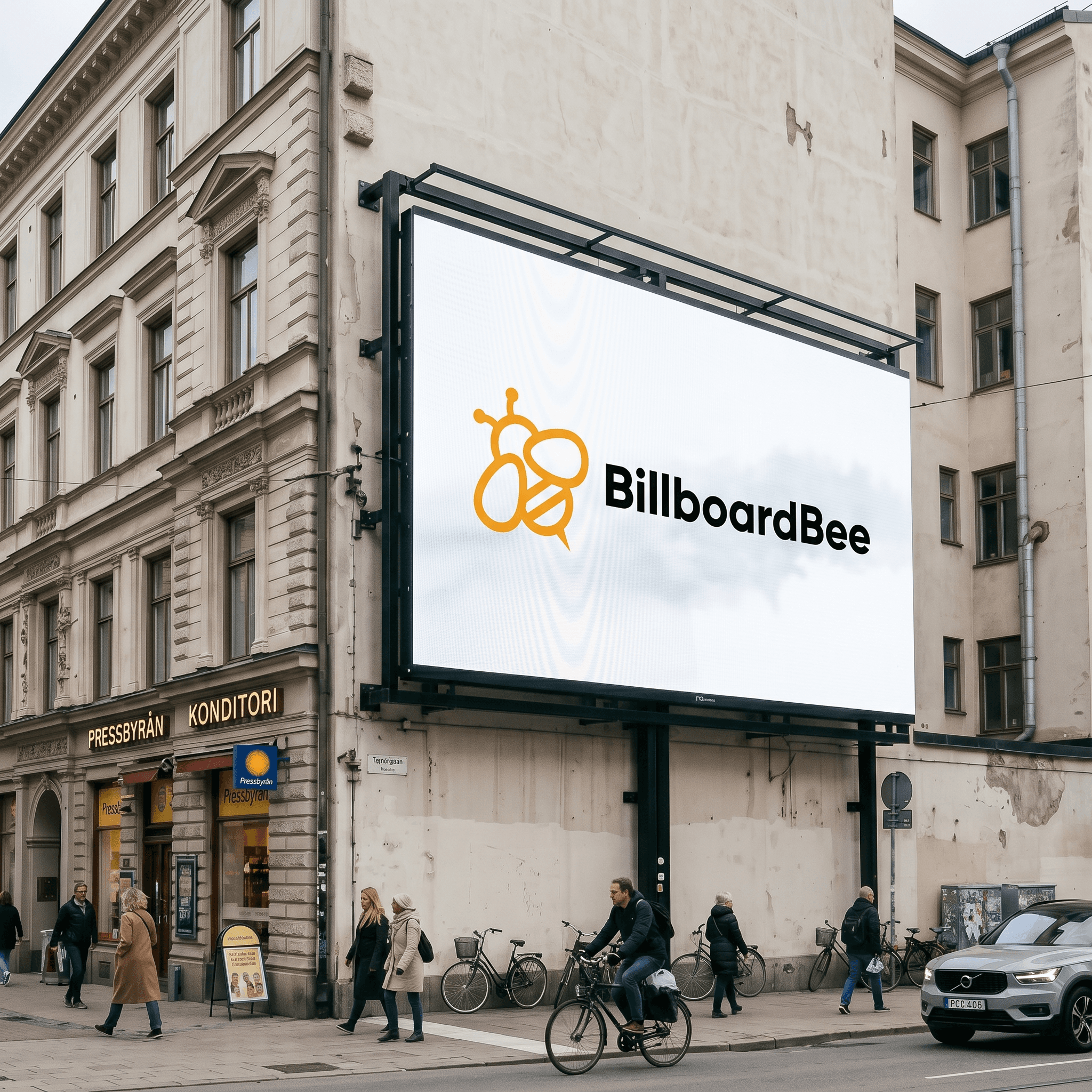
LED billboard vs Static poster
Comparison

LED billboard vs Static poster

Digital flexibility vs printed persistence

Main axis

Digital flexibility vs printed persistence

For Swedish advertisers, the choice between an LED billboard and a static poster is rarely about which format is "better" in general. It is about operational needs, campaign rhythm and how much flexibility your team actually needs once the booking is live. In Stockholm, Gothenburg, Malmö, Uppsala and Lund, both formats remain relevant across Clear Channel Sweden, JCDecaux Sweden and Bauer Media Outdoor networks. LED excels when timing, dayparting and creative variation matter. Static posters still make strong sense when the brief calls for broad visibility, simpler production and steady brand presence over the campaign window.

Key facts

The difference in 4 lines

Digital strength
Sweden is a highly digital OOH market

Useful when timing, triggers and flexible delivery matter.

Campaign timing
LED can be updated during the live run

Static posters usually stay fixed for the booked posting window and are changed physically.

Measurement currency
Swedish OOH planning commonly uses VAC

Outdoor Impact describes VAC as visibility-adjusted contacts.

City fit
Best choice depends on city, site and brief

Stockholm commuter hubs may favour LED flexibility, while classic posters still suit steady reach in Gothenburg, Malmö, Uppsala and Lund.

Differences

How they differ

1

LED can swap creatives any time; static posters are replaced physically every ~2 weeks

2

LED has 24/7 lighting; static posters often rely on backlight or spotlights

3

LED CPMs are typically higher; static posters tend to have lower production cost over time

4

LED enables same-day A/B testing; static posters lock in per campaign window

Recommendation

Which should you pick?

Pick LED billboard when

When a campaign needs quick updates, dayparting or creative variation.

Pick Static poster when

When budget is tight but long exposure and heavy brand presence is wanted.

Deep analysis

LED billboard vs Static poster in detail

The core trade-off: flexibility versus staying power

In the Swedish and wider Nordic out-of-home market, LED and static formats solve different planning problems. LED billboards let you update copy, offers or visuals without sending a crew to site, which is useful for launches, live retail messaging and campaigns that need to react to weekday patterns, weather or inventory. Static posters are less agile, but that limitation can also be a strength: once installed, the same creative sits consistently in view and supports long, uninterrupted brand exposure. For a busy marketing manager, the practical question is whether your campaign benefits more from control during the run or from a simpler, fixed delivery model.

Why LED billboards win on campaign agility

Sweden is one of Europe’s more digitally enabled OOH markets, and the infrastructure now supports dynamic buying and delivery at scale. JCDecaux Sweden highlights that digital campaigns can be adapted by weekday, time of day and even stock status, while Bauer Media Outdoor’s programmatic offer in Sweden is built for selected locations and specific periods of the day or week. That makes LED especially useful for retail bursts in central Stockholm, commuter messaging in Gothenburg, event promotion in Malmö, or student-facing campaigns in Uppsala and Lund where timing changes performance. LED also supports same-day creative swaps and A/B testing, so teams can learn and adjust during the campaign rather than after it ends.

Why static posters still matter in Sweden

Static posters remain a credible choice because they combine broad visibility with comparatively straightforward production and buying. In Swedish city and regional networks, classic poster and adshel formats still deliver meaningful reach and can be easier to plan when the message is stable for the full campaign window. For brand campaigns that do not need dayparting or multiple versions, printed posters often keep the workflow simpler: one approved artwork, one production cycle, one fixed campaign period. That can be attractive for local advertisers in Malmö or Lund, or for national brands that want dependable street-level presence without paying for digital flexibility they may not use.

Budget reality: media cost versus production logic

In the Swedish market, LED inventory usually carries a higher CPM and a higher media premium because it offers motion, flexibility, premium environments and shared-screen access in busy urban flows. Static formats often come with lower production complexity, and for longer visibility windows they can feel more cost-efficient if the same message runs unchanged. Rate cards from Swedish media owners show that digital and classic formats are priced very differently depending on city, network quality, share of voice and duration, so the smarter comparison is not a fixed price point but total campaign economics. If your team expects multiple copy updates, different dayparts or creative testing, LED can justify its premium. If the brief is stable and budget discipline is the main constraint, static posters often stretch further.

Placement and audience in a Swedish city mix

Placement matters as much as format. JCDecaux Sweden is particularly strong in public transport environments such as Stockholm’s bus shelters and major subway stations, while Bauer Media Outdoor offers large national coverage across digital and classic billboards. That means LED is often strongest in high-tempo commuter environments where relevance can shift by hour, while static posters continue to work well where repeated exposure and physical presence do the heavy lifting. In practice, a central Stockholm commuter campaign may benefit from digital rotation and scheduling, whereas a broader local presence in Gothenburg, Malmö or Uppsala may work perfectly well with printed poster networks. Across the Nordics, the same pattern broadly holds: digital is growing fast, but classic formats still carry weight in everyday reach planning.

A balanced decision for BillboardBee clients

Choose LED billboard when your campaign needs quick updates, dayparting, multiple creatives or testing across locations and times. Choose static poster when budget is tighter, the message is unlikely to change, and your goal is heavy, steady brand presence across the full campaign window. In many Swedish campaigns, the most effective answer is not either-or but a mix: static posters for consistent base coverage, then LED in premium locations for tactical bursts, launches or context-driven messaging. That balanced setup often reflects how modern outdoor planning works in Sweden, Norway, Denmark and Finland today.
FAQ

Common questions: LED billboard vs Static poster

Which format is usually more expensive in Sweden?

LED billboards typically command a higher CPM and a stronger media premium, especially in central urban environments and premium commuter locations. Static posters are often easier on budget when the same message can run without changes across the campaign period.

Does static always mean cheaper?

Not automatically. Premium classic sites in Stockholm or other major cities can still be significant investments. The real saving usually comes from simpler production logic and from avoiding digital flexibility that the campaign does not need.

When is LED worth the higher spend?

Usually when the campaign needs dayparting, multiple creatives, reactive messaging or same-week optimisation. If those features can improve relevance or reduce wasted impressions, the higher media cost can be justified.

BillboardBee-rådgivare
Talk to a strategist

Still not sure? We match the choice to your brief.

Send us your audience, budget and campaign window and you'll get a concrete recommendation between LED billboard and Static poster — grounded in Swedish market data and similar past campaigns.

  • Recommendation based on real Swedish campaigns
  • Realistic CPM ranges for both channels
  • Combined-channel setup if it actually helps you
  • Swedish advisors, reply within 1 h on weekdays

Sources & further reading

  1. 01.JCDecaux Sweden products
  2. 02.Bauer Media Outdoor Sweden
  3. 03.Bauer Media Outdoor Sweden programmatic DOOH
  4. 04.Outdoor Impact – how we measure
  5. 05.JCDecaux Sweden rate card 2026 · 2026-02-06

The comparison is based on publicly available Swedish/Nordic market data, industry reports and aggregated bookings from the BillboardBee platform.

Ready to book?

Find the right board for your campaign

Explore our full inventory for both formats – or let our team help you choose the right one.